Listing Site Updates
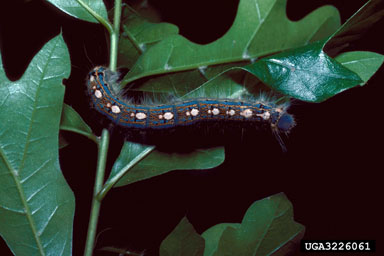
Please note that pictures found in this website have been taken from other sources. Therefore, I will recognize and acknowledge the efforts made by others in this section. Other pages have the photo cited beneath.You will find an ID number in the bottom right hand corner of each picture. The reference for this picture is shown below with its corresponding ID number. Texas Forest Service Archives, Image 3226061. http://forestryimages.org/
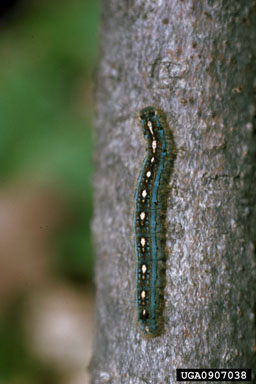
Walker, E. B. VDFPR. Image 0907038. http://forestryimages.org/
|
Key characteristics
Contrary to its name, the forest tent caterpillar does not form a tent, but rather it does spin silk threads for displacement. The larvae have keyhole shaped markings along the center of its back. The sides of its body are lined with light blue markings. Mature larvae are approximately 45 mm in length. |
Notifying Visitors of Site Enhancements
I will notify visitors of any changes or modifications to this website within this section.
Introduction
The forest tent caterpillar is one of the most serious defoliators in hardwood aspen stands. The insect not only attacks aspen, but also a wide range of tree species, such as birch, oak, basswood and under extreme cases of starvation, conifer species. Even though the caterpillar is not directly involved in the death of the host plant, the effects of its presence and damage becomes important for other natural events to take place. These proceedings might include fungal invasion, other insect damage or the host tree's susceptibility to abiotic stress related factors. An outbreak of the forest tent caterpillar can be a discomfort and an annoiance for homeowners, land stewards and city officials. |
Mike Liukko |